



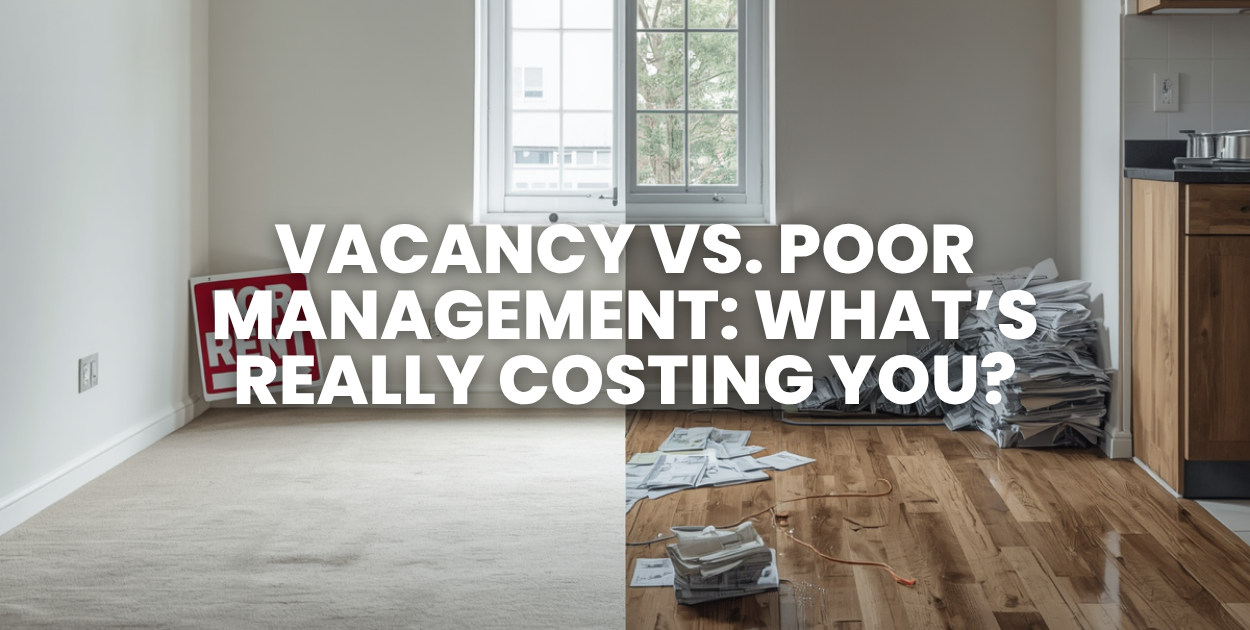
Vacancy vs. Poor Management: What’s Really Costing You?
If you are trying to decide whether to self-manage your rental property or hire a professional to avoid fees, you are likely asking yourself a critical question: What costs more—an empty property or a bad property manager?
While an empty unit is an obvious, painful drain on your bank account, poor property management is actually far more expensive than a vacancy over time. While a vacancy has a fixed, predictable end date, bad management creates a compounding financial drain through bad tenant screening, neglected maintenance, and legal liabilities that can damage your investment for years.
The True Cost of a Vacant Rental Property
Direct Answer: A vacant rental property costs an owner an average of 1.5 to 2 times the monthly rent in hidden carrying costs for every month it sits empty.
When a property sits vacant, you aren't just losing out on the market rent. You are also entirely responsible for the out-of-pocket expenses required to maintain the asset.
The Hidden Expenses of 1 Month of Vacancy:
The Lost Rental Income: The immediate loss of your baseline cash flow.
Mortgage & Holding Costs: You must cover the principal, interest, taxes, and insurance (PITI) completely out of pocket.
Utility Maintenance: Keeping the heat, electricity, and water running to prevent frozen pipes or mold growth.
Tenant Placement Fees: The marketing and advertising costs required to attract a new applicant.
The Compounding Cost of Poor Property Management
While a vacancy stops the bleeding the moment a lease is signed, a bad property manager (or an inexperienced landlord self-managing) creates hidden, long-term leaks. A rushed or lazy tenant screening process to "fix" a vacancy quickly is almost always where the largest financial disasters begin.
According to data tracking residential tenancy risks, property turnover and tenant damages are the two highest drivers of unrecovered costs for single-family rental owners.
How Bad Management Costs You More Than an Empty Unit:
Substandard Tenant Screening: Placing a tenant who fails to pay rent, damages the property, or requires a formal eviction.
Neglected Preventative Maintenance: Ignoring a minor plumbing leak until it warps the subfloor and turns into a toxic mold remediation. Research demonstrates that every dollar deferred on preventative maintenance results in an average of four dollars in future capital expenditures.
Legal & Fair Housing Violations: Missing local landlord-tenant law updates, mishandling a security deposit, or serving an incorrect notice can result in thousands of dollars in statutory fines.
Underpriced Rental Rates: Failing to adjust rents to true market values, costing you hundreds of dollars in realized profit every single month.
Cost Comparison: Vacancy vs. Poor Management
To see how these numbers play out in the real world, look at this side-by-side cost comparison based on a standard rental property with a market value of $2,500 per month.
Expense Category | 1 Month of Clean Vacancy | 1 Year of Poor Management / Bad Tenant |
Direct Income Loss | $2,500 (One month of lost rent) | $5,000+ (2 to 3 months of unpaid rent during eviction) |
Maintenance & Repairs | $0 (Normal wear and tear) | $4,500+ (Tenant property damage & deferred repair escalation) |
Legal & Administrative Fees | $0 | $2,500+ (Eviction filing fees, legal counsel, court costs) |
Holding & Utility Costs | $400 (Basic utilities & landscaping) | $0 (Covered by tenant, or gridlocked during non-payment) |
Total Estimated Risk | $2,900 | $12,000+ |
Frequently Asked Questions
How much does an empty rental property cost per day?
An empty rental property costs an owner approximately $85 to $100 per day on a property that rents for $2,500 per month. This accounts for both the lost pro-rated rent and the daily utility and carrying costs necessary to keep the building functional.
Is it cheaper to self-manage a rental property or hire a manager?
On paper, self-managing looks cheaper because you save the standard 8% to 12% monthly management fee. However, if an experienced manager prevents just one extra month of vacancy or avoids a single bad tenant placement, their optimization saves you thousands more than the cost of their annual fees.
What are the signs of a bad property manager?
The primary signs of a poor property manager include slow response times to maintenance requests, a vacancy rate significantly higher than your local market average, unreturned phone calls to owners, and a lack of transparent, monthly financial reporting.
The Verdict: Protect Your ROI with Systems
Minimizing vacancy is important, but rushing to fill a unit without professional, strict processes is a trap. A high-quality property manager uses deep local market knowledge to price your home perfectly, implements rigorous credit and background tracking to find stable long-term residents, and catches maintenance issues before they spiral.
Don't trade a short-term vacancy for a long-term management nightmare.
References
Garvin, M. J., & Molenaar, K. R. (2021). The compounding effect of deferred maintenance in real estate portfolios. Journal of Property Management & Real Estate Economics, 14(2), 112–126.
National Association of Residential Property Managers. (2024). The true financial impact of operational vacancy and tenant turnover on single-family rental assets [White Paper]. NARPM Research Division.
National Apartment Association. (2025). Industry survey of operational costs: The real dollar impact of tenant placement errors. NAA Press.